 World Future Review
November, Winter 2012 vol. 4 no. 4 19-27
doi: 10.1177/194675671200400405
Victor Grech
Abstract
It is fair to say that Star Trek comprises a selfcontained subgenre within science fiction (SF). Over nearly 50 years, through six distinct television series, and eleven feature length films, the “Star Trek universe” envisioned by Gene Roddenberry has become arguably the world's most elaborate and widely recognized depiction of life in future times (covering roughly the twenty-second through the twenty-ninth centuries). In this article, situations involving infertility occurring in episodes from different Star Trek series are examined and some general conclusions offered concerning the perception of this problem and the variety of responses proposed.
STAR TREK; INFERTILITY; MEDICINE IN SCIENCE FICTION
http://wfr.sagepub.com/content/4/4/19.abstract
Friday, 1 November 2013
Infertility in Star Trek


Saturday, 1 June 2013
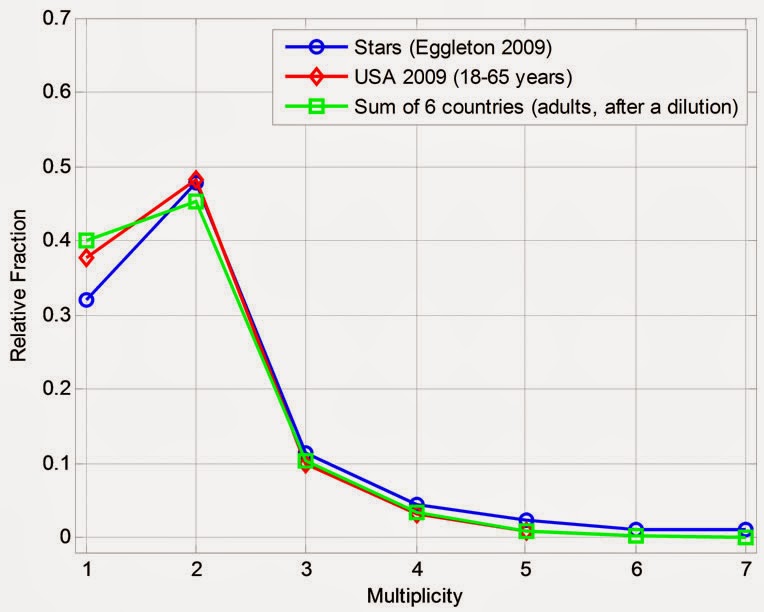
An Intriguing Correlation between the Distribution of Star Multiples and Human Adults in Household
 International Journal of Astronomy and Astrophysics
Vol. 3 No. 2, June 2013, pp. 153-160
DOI: 10.4236/ijaa.2013.32017
Alon Retter
Hamaccabim St., Shoham, Israel
Abstract
It is a known fact that like people, some stars are singles, many others tend to couple in binaries, and fewer are in triples etc. The distribution of multiplicity in the 4559 brightest nearby stars was matched with that of human adults in household in six countries, in which this information could be dug and estimated. A strong resemblance between the two curves is evident. Monte Carlo simulations suggest that this result is significant at a confidence level higher than 98%. Apparently, there should be no connection between the two populations, thus this striking result may supply some clues about the way Nature works. It is noted that extended versions of this work were proposed three years ago, and two predictions of this absurd model have already been verified.
http://www.scirp.org/journal/PaperInformation.aspx?PaperID=32738
http://file.scirp.org/Html/10-4500123_32738.htm
Thursday, 24 January 2013
Dung Beetles Use the Milky Way for Orientation
 Current Biology
Volume 23, Issue 4, 298-300, 24 January 2013
Marie Dacke [1, 2], Emily Baird [1], Marcus Byrne [2], Clarke H. Scholtz [3], Eric J. Warrant [1]
1 Department of Biology, Lund University, 223 62 Lund, Sweden
2 School of Animal, Plant and Environmental Sciences, University of the Witwatersrand, Wits 2050, South Africa
3 Department of Zoology and Entomology, University of Pretoria, Pretoria 0002, South Africa
Highlights
African dung beetles orient to the starry sky to move along straight paths
The beetles do not orientate to the individual stars, but to the Milky Way
Summary
When the moon is absent from the night sky, stars remain as celestial visual cues. Nonetheless, only birds, seals, and humans are known to use stars for orientation. African ball-rolling dung beetles exploit the sun, the moon, and the celestial polarization pattern to move along straight paths, away from the intense competition at the dung pile. Even on clear moonless nights, many beetles still manage to orientate along straight paths. This led us to hypothesize that dung beetles exploit the starry sky for orientation, a feat that has, to our knowledge, never been demonstrated in an insect. Here, we show that dung beetles transport their dung balls along straight paths under a starlit sky but lose this ability under overcast conditions. In a planetarium, the beetles orientate equally well when rolling under a full starlit sky as when only the Milky Way is present. The use of this bidirectional celestial cue for orientation has been proposed for vertebrates, spiders, and insects, but never proven. This finding represents the first convincing demonstration for the use of the starry sky for orientation in insects and provides the first documented use of the Milky Way for orientation in the animal kingdom.
http://www.cell.com/current-biology/retrieve/pii/S0960982212015072
http://www.sciencedirect.com/science/article/pii/S0960982212015072
Monday, 17 October 2005
Are patient falls in the hospital associated with lunar cycles? A retrospective observational study
 BMC Nursing 2005, 4:5
doi:10.1186/1472-6955-4-5
Schwendimann R, Joos F, De Geest S, Milisen K.
Institute of Nursing Science, University of Basel, Bernoullistrasse 28, 4056 Basel, Switzerland.
BACKGROUND:
Falls and associated negative outcomes in hospitalized patients are of significant concerns. The etiology of hospital inpatient falls is multifactorial, including both intrinsic and extrinsic factors. Anecdotes from clinical practice exist in which health care professionals express the idea that the number of patient falls increases during times of full moon. The aim of this study was to examine in-hospital patient fall rates and their associations with days of the week, months, seasons and lunar cycles.
METHODS:
3,842 fall incident reports of adult in-patients who fell while hospitalized in a 300-bed urban public hospital in Zurich, Switzerland were included. Adjusted fall rates per 1'000 patient days were compared with days of the week, months, and 62 complete lunar cycles from 1999 to 2003.
RESULTS:
The fall rate per 1000 patient days fluctuated slightly over the entire observation time, ranging from 8.4 falls to 9.7 falls per month (P = 0.757), and from 8.3 falls on Mondays to 9.3 falls on Saturdays (P = 0.587). The fall rate per 1000 patient days within the lunar days ranged from 7.2 falls on lunar day 17 to 10.6 falls on lunar day 20 (P = 0.575).
CONCLUSION:
The inpatient fall rates in this hospital were neither associated with days of the week, months, or seasons nor with lunar cycles such as full moon or new moon. Preventive strategies should be focused on patients' modifiable fall risk factors and the provision of organizational conditions which support a safe hospital environment.
http://www.biomedcentral.com/1472-6955/4/5